

来自今天的爱可可AI前沿推介
[LG] Identifiability of latent-variable and structural-equation models: from linear to nonlinear
A Hyvärinen, I Khemakhem, R Monti
[University of Helsinki & UCL]
潜变量和结构方程模型的可识别性:从线性到非线性
要点:
-
多变量统计中线性高斯模型的可识别性问题,以及非高斯性如何解决该问题; -
潜变量的非高斯性已被证明可以提供线性模型的可识别性,如因子分析和线性回归; -
如果时间序列或分布被观察到的辅助变量适当地调制,甚至此类模型的非参数非线性版本也可以被估计; -
回顾了线性和非线性模型的可识别性理论,包括因子分析和结构方程模型,并讨论了非线性ICA在使非线性SEM的可识别性和估计中的作用。
一句话总结:
回顾了线性高斯模型的可识别性问题,并展示了非高斯性如何能提供此类模型的可识别性,探讨了如何估计此类模型的非参数非线性版本,并讨论了非线性ICA在实现非线性结构方程模型的可识别性和估计方面的作用。
摘要:
多变量统计中的一个老问题,就是线性高斯模型往往是不可识别的,某些参数无法被唯一地估计。在因子分析中,因子的正交旋转是无法识别的,而在线性回归中,效应的方向无法识别。对于这样的线性模型,(潜在)变量的非高斯性已经被证明可以提供可识别性。在因子分析的情况下,这导致了独立成分分析,而在效应方向的情况下,结构方程模型的非高斯版本解决了这个问题。最近,已经表明,即使是一般的非参数非线性版本的此类模型也可以被估计。这种情况下,仅有非高斯性是不够的,但假设有时间序列,或者分布被一些观察到的辅助变量适当地调制,这些模型是可识别的。本文回顾了线性和非线性情况下的可识别性理论,同时考虑了因子分析模型和结构方程模型。
An old problem in multivariate statistics is that linear Gaussian models are often unidentifiable, i.e. some parameters cannot be uniquely estimated. In factor analysis, an orthogonal rotation of the factors is unidentifiable, while in linear regression, the direction of effect cannot be identified. For such linear models, non-Gaussianity of the (latent) variables has been shown to provide identifiability. In the case of factor analysis, this leads to independent component analysis, while in the case of the direction of effect, non-Gaussian versions of structural equation modelling solve the problem. More recently, we have shown how even general nonparametric nonlinear versions of such models can be estimated. Non-Gaussianity is not enough in this case, but assuming we have time series, or that the distributions are suitably modulated by some observed auxiliary variables, the models are identifiable. This paper reviews the identifiability theory for the linear and nonlinear cases, considering both factor analytic models and structural equation models.
论文链接:https://arxiv.org/abs/2302.02672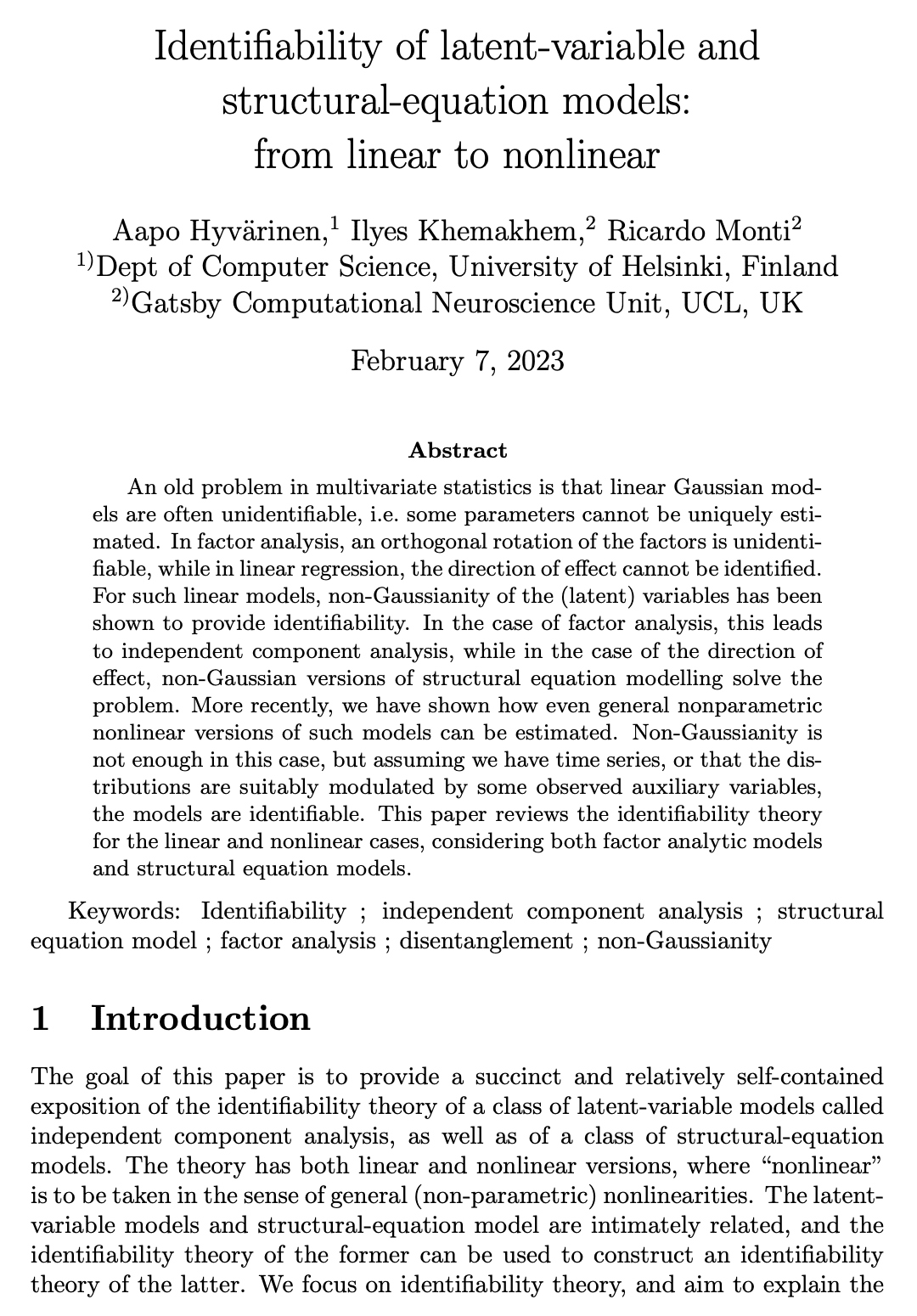
内容中包含的图片若涉及版权问题,请及时与我们联系删除

评论
沙发等你来抢