

Meta-Learning Triplet Network with Adaptive Margins for Few-Shot Named Entity Recognition
Chengcheng Han, Renyu Zhu, Jun Kuang, FengJiao Chen, Xiang Li, Ming Gao, Xuezhi Cao, Wei Wu
East China Normal University & Meituan Inc
用于小样本命名实体识别的具有自适应边距的元学习三元组网络
要点:
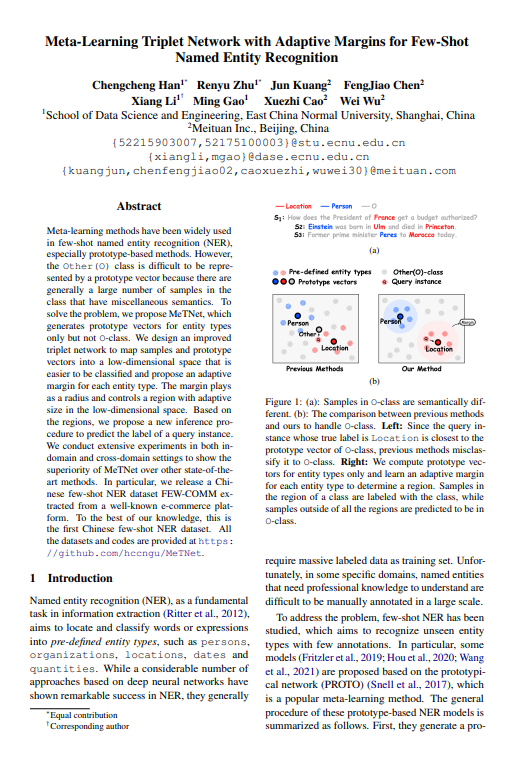
1.元学习方法已广泛用于少样本命名实体识别(NER),尤其是基于原型的方法。 然而,Other(O)类很难用原型向量表示,因为类中一般有大量样本,语义杂乱。
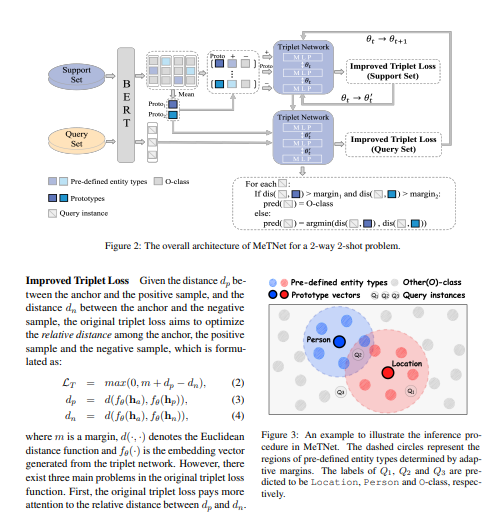
2.为了解决这个问题,我们提出了 MeTNet,它只为实体类型而不是 O 类生成原型向量。 我们设计了一个改进的三元组网络,将样本和原型向量映射到一个更容易分类的低维空间,并为每个实体类型提出自适应边距。 边距作为一个半径,在低维空间中控制一个大小自适应的区域。 基于这些区域,我们提出了一种新的推理过程来预测查询实例的标签。
一句话总结:
在域内和跨域设置中进行了大量实验,以展示 MeTNet 优于其他最先进方法的优势。 特别是,文章发布了从知名电子商务平台提取的中文小样本 NER 数据集 FEW-COMM。 据目前所知,这是第一个中国的小样本 NER 数据集。 所有数据集和代码都在 https://github.com/hccngu/MeTNet上提供。[机器学习+人工翻译]
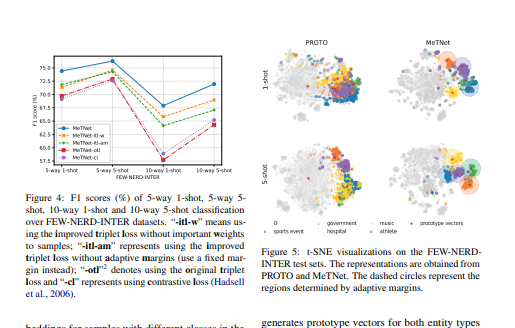
Meta-learning methods have been widely used in few-shot named entity recognition (NER), especially prototype-based methods. However, the Other(O) class is difficult to be represented by a prototype vector because there are generally a large number of samples in the class that have miscellaneous semantics. To solve the problem, we propose MeTNet, which generates prototype vectors for entity types only but not O-class. We design an improved triplet network to map samples and prototype vectors into a low-dimensional space that is easier to be classified and propose an adaptive margin for each entity type. The margin plays as a radius and controls a region with adaptive size in the low-dimensional space. Based on the regions, we propose a new inference procedure to predict the label of a query instance. We conduct extensive experiments in both in-domain and cross-domain settings to show the superiority of MeTNet over other state-of-the-art methods. In particular, we release a Chinese few-shot NER dataset FEW-COMM extracted from a well-known e-commerce platform. To the best of our knowledge, this is the first Chinese few-shot NER dataset. All the datasets and codes are provided at https://github.com/hccngu/MeTNet.
https://arxiv.org/pdf/2302.07739.pdf
内容中包含的图片若涉及版权问题,请及时与我们联系删除

评论
沙发等你来抢