

点击蓝字
关注我们

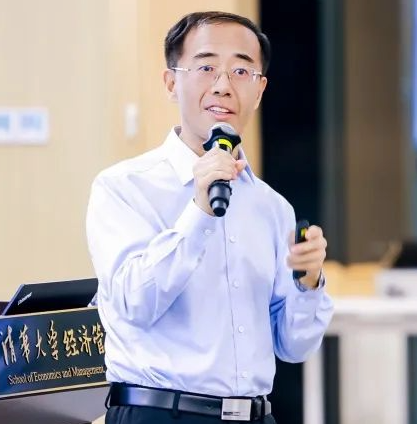
梁正
清华大学人工智能国际治理研究院副院长、人工智能治理研究中心主任、中国科技政策研究中心副主任、公共管理学院教授

在2025年12月30日《日经亚洲》(Nikkei Asia)刊发的专题报道中,清华大学公共管理学院教授、人工智能国际治理研究院副院长梁正就人工智能对就业的影响接受采访,从制度结构与产业路径层面对相关焦虑作出分析解读。
梁正指出,与美国相比,中国人工智能的部署方式更偏向生产率提升工具,而非直接替代劳动力,技术更多嵌入制造体系和硬件环节,在服务业中的替代效应相对有限,因此短期内尚未形成大规模就业冲击。
他表示,过去两年间,中国政府已对人工智能的就业影响开展系统性评估,并持续向相关领域专家征询意见。近期多份政策文件强调“人机协作”和“平稳过渡”,反映出政策层面对技术扩散可能带来的结构性冲击保持高度警惕,并力图通过前置治理加以引导。
梁正进一步指出,相关部门正重点关注人工智能在制造业、自动驾驶等领域的潜在替代效应,密切跟踪其对就业结构的长期影响。在他看来,中国的经济与治理体系在推动人工智能发展的同时,更加重视技术的安全性、可靠性与社会均衡目标,政策重点在于提升劳动者的人工智能素养,推动技术创造新岗位和新分工,而非简单“用机器替代人”。以下是报道全文:
HONG KONG/PALO ALTO, California -- Frances Xu has not yet seen any widespread layoffs around her, but that has not stopped the thirtysomething marketing director in Hong Kong from worrying that artificial intelligence could soon take her job.
To prepare for that possibility, Xu has started studying traditional Chinese medicine in her spare time. Worried that even consultations could eventually be replaced by AI, she is instead focusing on therapeutic massage and acupuncture, which she believes are less likely to be automated, as each person's joint issues could be different.
"I'm not rich, I'm still single, and I need to support my parents," Xu told Nikkei Asia. "That gives me a strong sense of crisis about my job prospects."
In the U.S., 2025 is set to end with the worst job losses in recent years, with many pointing to AI as a key driver of the layoffs, though some companies argue the technology is changing roles rather than eliminating them.
In China, layoffs tend to be less visible and smaller in scale, but AI is nonetheless disrupting a range of industries, and for many, fears of future job displacement are increasingly real.
A recent McKinsey report showed 36% of companies surveyed in Greater China are expecting workforce reduction due to AI over the coming years, with 21% of those surveyed expecting AI to lead to workforce decreases of 11% or more in the next year.
At a November event, Ren Zhengfei, CEO of Chinese tech giant Huawei, said the U.S. and China have "different focuses" in their pursuit of AI. While the U.S. might be looking more at big-picture questions such as what is the future of human society in the AI era, China is more interested in the real-world applications of the technology, such as improving public safety, health care and education.
During the process, however, "we will face the task of streamlining many positions," said Ren, adding that AI can free up about 30% of the workload for software engineers today and up to 60% to 70% in the future.
Big companies such as Tencent and Baidu both recently said that AI now contributes to over 50% of their new code generation, though neither said it was laying off engineers because of that.
"AI should liberate humans from repetitive tasks and deliver immediate benefits and efficiency gains," Baidu founder Robin Li said last month.
A director of content from one of China's most valuable companies, who asked not to be named, said it is getting more difficult to get approvals to increase head count for her department, as now she must first explain to the company why the job cannot be done by AI.
A director at another leading tech company told Nikkei Asia that some roles previously requiring five years of experience are now being filled by candidates with just two to three years on the job. With the help of AI, more junior employees can perform the same tasks, allowing companies to reduce costs, the director said.
"What we see now is that the employment impact has been felt most acutely by young people, as some private companies have paused hiring," said Helen Qiao, a managing director and chief economist for Greater China at Bank of America.
While China's adoption of new applications is no slower than in the U.S., the shock to new graduates has been less severe than in America, she added. "In China, state-owned enterprises continue to shoulder some social responsibility, cushioning the impact," she said.
Despite China's sluggish economic growth, triggered by a property crisis and fierce competition squeezing corporate profits, and simmering trade tensions with the U.S. and Europe, the number of university graduates continues to hit record highs, with an estimated 12.7 million graduates expected in 2026 -- 480,000 more than in 2025.
In August, the nationwide urban unemployment rate for people aged 16 to 24, excluding students, hit 18.9%, the highest level since 2024, though it improved in November to 16.9%.
The situation is further compounded by many Chinese companies pursuing strategic small-scale layoffs in recent years, which are still ongoing. A senior executive at a major e-commerce company told Nikkei Asia that large-scale layoffs, such as cuts of more than 10% of the workforce across a big company, would require advance notification to the government to prevent potential unrest. He added that in recent years, his team has reduced staff by about 5% annually, a common practice in Chinese Big Tech, while continuing to hire selectively.
Neale Mahoney, an applied micro-economist at Stanford University and director of the Stanford Institute for Economic Policy Research, drew a parallel with a famous Agatha Christie novel.
"It may end up being a 'Murder on the Orient Express.' The weakness in the economy has many perpetrators," Mahoney said, pointing to the trade war and slowing domestic growth.
On the AI front, Liang Zheng, a professor of the School of Public Policy and Management at Tsinghua University, said that compared to the U.S., the technology is being deployed less in the service sector in China and more as a productivity tool, as well as being embedded into hardware. As a result, its labor-substitution effect remains limited for now.
"In the past two years, the government has been assessing AI's labor impact and consulting experts. Recent government policy documents emphasize human-machine collaboration and a smooth transition, reflecting an effort to manage disruption," Liang told Nikkei Asia.
Liang added that officials are closely watching whether AI will replace more workers in the future, particularly in the manufacturing and robotaxi sectors.
"China's economic system places priority on ensuring AI is safe, reliable, and socially balanced, with a focus on improving workers' AI literacy and encouraging the technology to create new jobs rather than simply eliminate existing ones," he said.
Several programmers at state-owned enterprises said that they believe the future relationship between AI and software engineers will resemble that between highly automated factories and workers today: AI will significantly boost efficiency but will not completely replace humans -- though low-end programmers will no longer be needed.
"While AI has not replaced people on a large scale, it is reshaping the business logic of major internet companies," said one programmer at a state-owned enterprise.
And despite CEO Ren's caution on the pace of automation, two Huawei employees told Nikkei Asia that AI is putting pressure on their work within the company.
"No one will say out loud that 'AI will take your job', but the expectations from management have become higher and higher because of AI. Some managers will ask for a crazy high number of lines of code you need to churn out everyday because they think AI can code half of it," said a software engineer at Huawei Cloud.
AI is not the only reason for such high expectations from managers, said the other employee, speaking on condition of anonymity. The Chinese tech giant is under immense pressure from U.S. sanctions and reported a 32% drop in net profit during the six months from January to June as it continues to invest heavily in research and development to offset the impact on tech curbs.
"The fear of layoffs is real inside the company, not because of AI, but because business performance is not looking too good this year," the employee said.
Huawei did not respond to Nikkei Asia's request for comment.
Meanwhile, the relatively low cost of labor in China means replacing human workers with AI is less of a priority for some businesses.
Liang, who asked to be identified only by his surname, manufactures sports apparel in Guangdong province for overseas brands. The seasoned apparel maker installed a full set of automated production line equipment in his factories nearly two years ago, but the machines are now sitting idle.
"Like a lot of factory owners, I was so excited about automation and any opportunity to cut down the manufacturing cost, but it turns out the start-up cost of running new equipment in a factory is high," Liang said.
"It's still quite cheap to hire experienced workers who can make better clothes than what machines can do now, so it does not really make sense for us to get rid of human workers."

内容中包含的图片若涉及版权问题,请及时与我们联系删除

评论
沙发等你来抢