



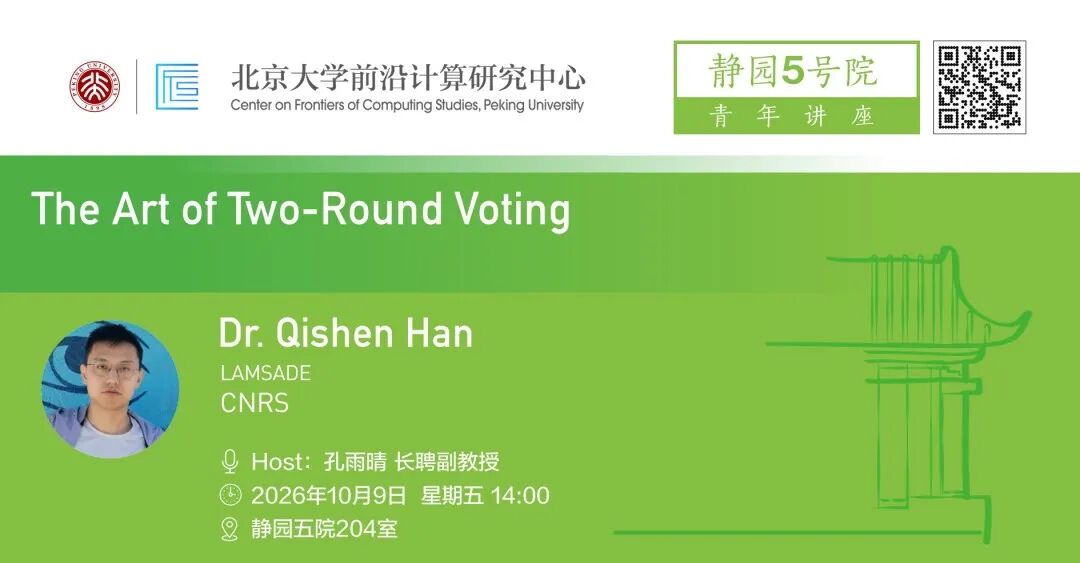
The Art of Two-Round Voting
报告人
Dr. Qishen Han
LAMSADE, CNRS
时 间
2026年10月9日 星期五 2:00pm
地 点
静园五院204
Host
孔雨晴 长聘副教授
Abstract
We study the voting problem with two alternatives where voters' preferences depend on a not-directly-observable state variable. While equilibria in the one-round voting mechanisms lead to a good decision, they are usually hard to compute and follow.
We consider the two-round voting mechanism where the first round serves as a polling stage and the winning alternative only depends on the outcome of the second round. We show that the two-round voting mechanism is a powerful tool for making collective decisions.
Firstly, every (approximated) equilibrium in the two-round voting mechanisms (asymptotically) leads to the decision preferred by the majority as if the state of the world were revealed to the voters. Moreover, there exist natural equilibria in the two-round game following intuitive behaviors such as informative voting, sincere voting, and surprisingly popular strategies. This sharply contrasts with the one-round voting mechanisms in the previous literature, where no simple equilibrium is known.
Finally, we show that every equilibrium in the standard one-round majority vote mechanism gives an equilibrium in the two-round mechanisms that is not more complicated. Therefore, the two-round voting mechanism provides a natural equilibrium in every instance, including those where one-round voting fails, and it can reach an informed majority decision whenever one-round voting can. Our experiments on LLM voters also imply that two-round voting leads to the correct outcome more often than one-round voting under some circumstances.
Biography

Qishen Han is a forthcoming Postdoc Researcher at LAMSADE, CNRS. He received his Ph.D. in Computer Science at Rutgers University, co-advised by Prof. Lirong Xia and Prof. David Pennock. Prior to that, he received a B.S. degree in Intelligence Science and Technology, as a member of Turing Honor Class, and a B.Ec. dual degree in Economics from Peking University.He works on computational social choice, with a focus on strategic voting and information aggregation, multiwinner representation, and the intersection on AI and social choice.

往 期 讲 座

静5杰出讲座回顾 | 周红院长谈协同发展准确、高效与创造性智能
静5杰出讲座回顾 | 马毅教授谈智能本质与人工智能的未来发展

— 版权声明 —
本微信公众号所有内容,由北京大学前沿计算研究中心微信自身创作、收集的文字、图片和音视频资料,版权属北京大学前沿计算研究中心微信所有;从公开渠道收集、整理及授权转载的文字、图片和音视频资料,版权属原作者。本公众号内容原作者如不愿意在本号刊登内容,请及时通知本号,予以删除。

内容中包含的图片若涉及版权问题,请及时与我们联系删除


评论
沙发等你来抢